Chongqing Opens a Hospital-Led Access Route for Clinically Urgently Needed Imported Medicines and Medical Devices
On August 4, 2026, the Chongqing Municipal Medical Products Administration, Municipal Health Commission, Municipal Healthcare Security Administration and Chongqing Customs jointly published a new two-year trial framework for the temporary import of clinically urgently needed medicines and medical devices.
The official Chongqing work plan does not create a blanket exemption from China registration. Instead, it operationalizes China’s existing national temporary-import rules within Chongqing: an eligible hospital may seek approval to import a limited quantity of a qualifying overseas-marketed product for a defined clinical need and use it only in designated medical institutions for the approved purpose.
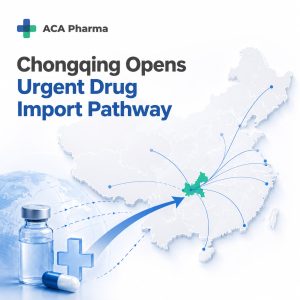
That distinction matters. This is not national marketing authorization and it is not an open commercial-import channel. It is, however, a meaningful new access route in one of China’s four direct-administered municipalities—a market with approximately 31.9 million residents—and may allow appropriate patients to receive certain therapies before full national registration.
Which medicines may qualify?
The Chongqing framework applies the eligibility standards in the national Clinical Urgently Needed Drugs Temporary Import Work Plan, issued in 2022 by the National Health Commission and National Medical Products Administration.
A medicine must already be marketed outside China and fall within the national criteria—for example, it is not registered in China, has no domestic producer, or domestic production cannot be restored in the short term. The requested quantity must be limited, and the product must satisfy at least one of the following clinical-need tests:
- It treats a rare disease;
- It treats or prevents a serious, life-threatening disease for which no effective option is available; or
- It treats or prevents a serious, life-threatening disease and offers a clear clinical advantage over available options.
Overseas approval alone is therefore not sufficient. Eligibility depends on the product’s status in China, the unmet clinical need, the requesting hospital’s capabilities and the reasonableness of the requested quantity.
What about medical devices?
The framework also covers certain Class II and Class III medical devices that are already marketed overseas but have no equivalent product approved in China. Under the national medical-device rules, the device must be clinically necessary for the treatment or prevention of a serious, life-threatening disease where no effective domestic option exists. Large medical equipment subject to separate configuration licensing is excluded.
How the Chongqing process is intended to work
The new framework is important because it adds a defined local support structure around the national approval process.
1. A qualified medical institution identifies the clinical need
The application is hospital-led. Eligible Chongqing medical institutions may raise a temporary-import need with the municipal drug regulator and health authority and seek guidance on the required application materials.
2. Chongqing conducts an early assessment
For medicines, the municipal drug regulator will conduct an upfront review of the product’s status, including whether it is marketed overseas and unavailable in China under the applicable criteria. The municipal health authority will assess whether the hospital has the necessary specialty expertise and product-management capabilities, whether the medicine is genuinely clinically urgent, and whether the requested volume is reasonable.
This is designed to move local assessment earlier in the process and reduce repeated revisions. Chongqing’s accompanying official policy interpretation describes the approach as changing parts of the review from sequential to parallel processing.
3. The hospital submits the national application
The Chongqing authorities will guide the hospital in applying to the National Medical Products Administration under the national framework. The NMPA may consult the National Health Commission on the hospital’s capabilities, clinical urgency and requested quantity before issuing a written approval.
The national service standard provides for an NMPA decision within three working days after receipt of the National Health Commission’s written feedback. This is not a three-day end-to-end approval promise: hospital preparation, local assessment and national health-authority review occur before that final decision stage.
4. Approved products receive expedited import support
After a medicine receives the required national approval, the Chongqing drug regulator is to issue the Import Drug Customs Clearance Form within one working day, and Chongqing Customs will facilitate clearance. Approved temporary-import medicines do not require port testing.
Medicines stocked in a Chongqing special customs-supervision zone or Type-B bonded logistics center may be released in multiple shipments within the approved batches and quantities. Medical devices follow a separate process and remain subject to legally required customs inspection. Narcotic and specified psychotropic medicines require an additional NMPA import permit.
5. Use remains controlled and fully traceable
Imported medicines must be used only by the designated institutions for the approved medical purpose. Hospitals must establish clinical protocols, identify the relevant patients, departments and physicians, obtain written informed consent, maintain appropriate storage and preserve clinical records.
Chongqing will use its municipal digital drug-safety platform, “渝药安,” to trace medicines from entry and warehousing through hospital delivery and patient use. Hospitals and importers must also comply with adverse-event reporting and risk-management requirements, and regulators may suspend use if safety concerns arise.
Repeat imports should become easier
The plan expressly allows a simplified assessment for repeat applications. If the medicine and hospital remain unchanged, the original assessment may be reused and the review can focus primarily on quantity. If the medicine is unchanged but a new hospital applies, the review can focus on that institution’s clinical and management capabilities and its requested volume.
This may be one of the framework’s most commercially important features. A pathway based entirely on one-off exceptions is difficult to sustain; a defined repeat-import process gives hospitals and suppliers greater operational visibility while preserving case-by-case oversight.
What the policy means for international manufacturers
For manufacturers of rare-disease, specialty and other clinically differentiated products, Chongqing adds another potential early-access point in Mainland China. It may be particularly relevant where physicians can identify a defined patient population and demonstrate that existing domestic options are absent or clinically inadequate.
The policy also creates practical infrastructure around access:
- Local guidance before national submission;
- Earlier assessment of the hospital, product and requested volume;
- Simplified review for qualifying repeat imports;
- A one-working-day local customs-document target after national approval;
- Bonded-storage flexibility for approved batches and quantities;
- Municipal procurement support and full-chain traceability.
However, companies should not treat Chongqing’s population as an immediately addressable commercial market. Access remains institution-specific and need-based. The framework does not authorize general promotion or distribution, does not guarantee approval, and does not place a product on China’s National Reimbursement Drug List. Chongqing’s medical-security authority will support compliant transaction and procurement processes, while the plan encourages commercial insurance and risk-compensation solutions; it does not promise public reimbursement.
From early access toward a broader China strategy
The Chongqing plan explicitly encourages overseas-marketed products to pursue national registration in China and provides for policy guidance through the NMPA’s Southwest Center. In practical terms, temporary import can provide early physician and patient access, operational experience and locally generated clinical-use information. Whether and how any resulting data can support a future registration filing will remain product-specific and subject to NMPA requirements.
Accordingly, the best strategy is not to view temporary import as a substitute for national registration. It is a controlled early-access tool that can sit alongside Macau, the Guangdong–Hong Kong–Macao Greater Bay Area, Hainan and other hospital-led pathways within a staged Greater China market-entry plan.
How ACA Pharma can help
ACA Pharma works with international medicine and medical-device companies to evaluate accelerated and early-access opportunities across Greater China. For products potentially suited to the Chongqing framework, ACA can support product and market validation, hospital and expert engagement, regulatory planning, compliant import and distribution, pharmacovigilance, and the longer-term commercialization strategy.
The new framework is a real opening, but not a shortcut around clinical need or regulatory control. Its value lies in converting a national legal mechanism into a more practical local process—giving eligible hospitals a clearer way to request important overseas therapies and giving manufacturers another disciplined route to reach patients who may otherwise have no suitable option.
To assess whether a product may qualify for the Chongqing pathway or another Greater China early-access channel, contact ACA Pharma at info@acapharma.net.
Primary Sources
- Chongqing Municipal Medical Products Administration: Trial Work Plan for Temporary Import of Clinically Urgently Needed Medicines and Medical Devices, published August 4, 2026
- Official Chongqing policy interpretation
- National Health Commission and NMPA: Clinical Urgently Needed Drugs Temporary Import Work Plan
- NMPA service guide for hospital applications to temporarily import small quantities of clinically urgently needed medicines
- NMPA: National requirements for temporary import and use of clinically urgently needed medical devices
This article is provided for general informational purposes and does not constitute legal, regulatory or medical advice. Product eligibility and procedural requirements must be confirmed case by case with the relevant authorities and medical institutions.