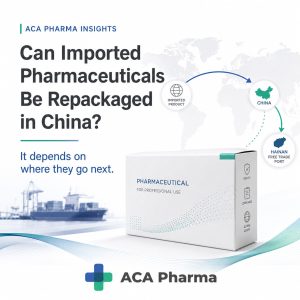
Why packaging, regulatory documentation and final destination can determine whether a simple carton issue becomes a pharmaceutical manufacturing issue.
For imported pharmaceuticals, changing a carton can be much more than a logistics exercise. Depending on where the product is packaged, how it entered China and where it will ultimately be supplied, secondary packaging may become part of the regulated manufacturing chain. Hainan and Macau create important opportunities—but only if the regulatory documentation, commercial presentation and supply-chain structure are aligned from the beginning.
A Carton Can Become a Regulatory Problem
For an international pharmaceutical company entering Greater China, packaging may seem like one of the easier items on the launch checklist.
The medicine is already approved. The finished product already exists. The manufacturer has a commercial carton, label and package insert. If a local market needs something different, the intuitive answer may be: import the product first and adjust the packaging locally.
In China, that assumption can be expensive.
The question is not simply:
“Can we change the box?”
The more important questions are:
- What regulatory pathway is being used to bring the product into the market?
- What commercial presentation is supported by the product’s foreign approval documentation?
- Where is the packaging operation performed?
- Does the activity constitute regulated pharmaceutical packaging or merely preparation of packaging materials?
- Is the product being re-exported after the activity?
- Or will the resulting product be supplied for use in mainland China?
Those distinctions can produce very different regulatory outcomes.
This is particularly important for companies exploring Macau, the Guangdong-Hong Kong-Macau Greater Bay Area, Hainan’s Boao Lecheng International Medical Tourism Pilot Zone, and other early-access channels before full national registration in China.
The strategic lesson is straightforward:
Packaging architecture should be considered before the access pathway is finalized—not after the first shipment is ready to leave the factory.
1. In Pharmaceuticals, Packaging Is Not Just Logistics
The first misconception to eliminate is that secondary packaging is merely a warehousing or distribution function.
Under China’s pharmaceutical GMP framework, “packaging” is defined broadly. It encompasses the operations required to convert a product awaiting packaging into a finished product, including activities such as filling into packaging and labeling. The same GMP rules require pharmaceutical manufacturing and packaging to follow approved processes and operating procedures, with packaging materials, printed components and packaging records tightly controlled.
That distinction matters.
Moving sealed cartons between warehouses is logistics.
Printing an empty carton may be packaging-material production.
But taking pharmaceutical product and performing activities such as repackaging, relabeling, inserting it into a new commercial presentation or otherwise completing its finished presentation can enter the pharmaceutical manufacturing/GMP framework.
China’s national drug registration system reinforces this concept. When NMPA approves a drug, it reviews the manufacturing process, labeling and package insert as part of the approval. NMPA’s current certificate format for overseas-manufactured products even contains a field for the packaging site, demonstrating that the location of packaging can be part of the formally recognized manufacturing configuration.
This is why a seemingly small packaging change can have consequences far beyond artwork.
2. The Most Important Question May Be: Where Is the Product Going Next?
Consider two superficially similar scenarios.
Scenario A: Product enters Hainan, is packaged, and is exported again
A pharmaceutical product enters Hainan from outside China. Certain packaging or processing activities are performed there, and the resulting product is then exported outside China.
Scenario B: Product enters Hainan, is packaged, and is then supplied into mainland China
The physical packaging operation may look identical.
The regulatory analysis is not.
China’s customs system expressly recognizes processing-trade structures in which imported goods are processed under customs supervision and the resulting products are subsequently re-exported. The customs rules treat the domestic sale of those goods differently: when processed goods are diverted to the domestic market, customs formalities, taxes and any applicable import licensing requirements come into play.
Hainan’s Free Trade Port structure makes that distinction even more important.
Under the current Hainan regime, the island has an external customs “first line” with overseas markets and a “second line” between Hainan and the rest of mainland China. Goods moving from Hainan into mainland China can therefore face a different regulatory and customs analysis from goods entering Hainan and subsequently leaving China.
That does not mean that any pharmaceutical can automatically be imported into Hainan, repackaged and exported.
Pharmaceutical licensing, GMP, product-specific controls and customs requirements still have to be satisfied.
But it explains why the ultimate destination of the product can materially change the regulatory structure.
3. Hainan’s Free Trade Status Does Not Override Pharmaceutical Regulation
Hainan creates unusually flexible trade and processing possibilities, but it is important not to confuse customs flexibility with drug regulatory approval.
Those are separate layers.
Hainan’s current rules provide significant benefits for imported materials and local processing. For qualifying goods processed in Hainan and subsequently entering mainland China, a 30% value-added threshold can in certain circumstances provide customs-duty benefits.
But there is an especially relevant detail for pharmaceutical companies:
simple changes to packaging do not themselves qualify as the type of value-added processing needed to obtain the 30% processing benefit.
Official Hainan guidance has specifically identified activities such as changing packaging, splitting packages and combining packages as forms of minor processing that do not by themselves satisfy the value-added policy.
That is a useful illustration of the broader principle.
A company cannot assume that because Hainan is a Free Trade Port, performing a packaging operation there automatically converts the finished pharmaceutical into a product that can freely enter the mainland market.
For medicines, the drug-regulatory question remains:
Is this packaging operation compatible with the authorization under which the medicine is being supplied?
4. Special Import Is Not the Same Thing as National China Registration
This distinction becomes particularly important for medicines entering through early-access, urgent-clinical-need or special-import mechanisms.
A product supplied under one of these mechanisms has not necessarily obtained a normal national Chinese marketing authorization.
Boao Lecheng is a good example.
Hainan permits designated medical institutions in the Lecheng Pilot Zone to seek access to qualifying clinically urgently needed imported medicines that are not yet nationally available in China. In 2026, Hainan introduced a formal pre-review mechanism intended to accelerate the later hospital-specific approval process for qualifying imported medicines and medical devices.
But the authorities still require extensive product-level identification.
The current Hainan pre-review rules require, among other items:
- proof of foreign marketing authorization;
- product basic information;
- the packaging used for the product overseas;
- labels;
- prescribing information; and
- complete images of the actual commercial presentation.
Hainan’s July 2026 regulatory notice also emphasizes end-to-end traceability covering application, procurement, importation, distribution, use and safety monitoring.
In other words, the regulator is not approving an abstract molecule.
It is assessing an identifiable pharmaceutical product and its documented commercial presentation.
That makes the relationship between regulatory documentation and the physical product being shipped important.
5. Why the CPP, Foreign Approval and Carton Need to Tell the Same Story
International manufacturers often hear the phrase:
“The CPP needs to match the carton.”
That is useful shorthand, but it should not be interpreted as meaning that every graphic element on a carton must literally appear on a Certificate of Pharmaceutical Product.
A CPP does not normally reproduce the entire commercial artwork.
The real issue is regulatory identity.
Depending on the pathway and jurisdiction, regulators may compare information across:
- the Certificate of Pharmaceutical Product or other proof of foreign authorization;
- the foreign marketing authorization;
- product name;
- dosage form;
- strength;
- manufacturer;
- marketing authorization holder;
- manufacturing and packaging sites;
- package configuration;
- label;
- prescribing information;
- outer carton; and
- the physical product proposed for importation.
If those documents collectively describe the same commercial product, the pathway is generally much cleaner.
If they appear to describe different presentations, additional questions arise.
For example:
The regulatory certificate supports Product X manufactured by Company A, while the carton being shipped identifies Company B, uses a different product name, represents a different market presentation, or comes from a packaging configuration that cannot readily be tied to the approval documentation.
The medicine inside may be chemically identical.
Regulatorily, however, the authority still needs to establish that the product being imported is the product supported by the submitted authorization.
This is why packaging-document alignment should be treated as an upstream market-access issue rather than a downstream artwork issue.
6. Macau Illustrates Why the Existing English Commercial Pack Can Be Extremely Valuable
Macau provides a particularly useful example.
Macau’s pharmaceutical import rules require supporting documentation before a medicine is authorized for import, including a foreign registration certificate or equivalent documentation, manufacturing authorization or equivalent evidence, an outer-packaging sample, and prescribing information.
The outer carton is therefore not an incidental item added at the end of the process. It forms part of what the regulator reviews.
At the same time, Macau can provide a major practical advantage for international manufacturers: the required information on a western medicine’s packaging may be presented in Chinese, Portuguese or English.
That creates an important strategic opportunity.
Where an internationally approved English-language commercial pack already contains the necessary information and aligns with the regulatory evidence being submitted, it may be possible to preserve that existing presentation rather than create an entirely new localized commercial pack.
For a manufacturer, that can avoid:
- new artwork development;
- packaging-line changeovers;
- additional packaging-site qualification;
- small-volume packaging runs;
- new component inventories;
- additional QA release complexity;
- supply-chain delays; and
- avoidable change-control work.
For an orphan, rare-disease or specialist hospital product with relatively low initial volumes, those savings can be disproportionately important.
The objective should therefore be:
Preserve the manufacturer’s existing internationally approved presentation whenever the applicable regulatory pathway allows it.
7. A Packaging Mismatch Can Turn a Simple Import Project Into a Manufacturing Project
Suppose the original pack cannot be used.
The first instinct may be:
“No problem. We will import the product and change the carton locally.”
That solution can create more problems than it solves.
Once a finished pharmaceutical is subjected to a regulated packaging operation, the company may need to consider issues including:
- whether the packaging location must be an authorized pharmaceutical manufacturing site;
- whether it needs to appear within the approved manufacturing chain;
- GMP requirements;
- packaging batch records;
- printed-component controls;
- quality agreements;
- manufacturer responsibilities;
- product release;
- change-control procedures;
- regulatory variation requirements;
- customs status;
- traceability; and
- whether the pathway under which the product entered the jurisdiction permits the operation at all.
China’s GMP framework treats packaging as a controlled pharmaceutical operation and requires printed packaging materials to correspond to regulator-approved information. It also requires individual packaging records capable of tracing the packaging history of each batch.
For a nationally registered Chinese medicine, such requirements can be incorporated into the approved manufacturing configuration.
For a product entering under a temporary or special-access structure, that may be a very different proposition.
8. Why “Import It First and Fix It Later” Can Be the Wrong Strategy
ACA Pharma’s local teams encounter this issue in real-world market-access planning.
A manufacturer may have:
- a clinically attractive product;
- an overseas approval;
- physician interest;
- an available Greater China access pathway; and
- product ready for shipment.
Then the packaging review begins.
A discrepancy is discovered between the documents supporting the product and the commercial presentation actually available for shipment.
At that point, every solution is harder.
Changing the physical product’s packaging location can affect the manufacturing structure.
Changing the regulatory documentation can take time.
Creating a new market-specific pack can be commercially unattractive for small early-access volumes.
Introducing local repackaging can create GMP and licensing questions.
And moving a special-import product into a domestic manufacturing step can create an entirely different regulatory analysis from importing the original overseas commercial product intact.
This is why ACA’s preferred sequence is the opposite:
- First determine the regulatory presentation.
- Then determine the supply route.
- Then determine whether the existing commercial pack can be preserved.
- Only then design any additional packaging solution.
9. Hainan Shows That Packaging Differences Are Not Necessarily Fatal
There is an important counterpoint: a packaging difference does not automatically disqualify a product.
Hainan’s own 2026 regulatory guidance recognizes this.
The Hainan Drug and Medical Device Evaluation Service Center states that medicines packaged in Hong Kong, Macau and certain other jurisdictions may still qualify for Lecheng special access where quality documentation demonstrates that the product is otherwise the same as the corresponding product marketed in an ICH member jurisdiction—including the same quality, origin and indication—even if the packaging itself differs.
The same guidance states that a product’s English generic name should correspond with the authenticated overseas marketing authorization, prescribing information or outer-packaging image.
That is an important practical development.
It shows that regulators can distinguish between:
- a legitimate alternative commercial presentation of the same pharmaceutical product; and
- a packaging discrepancy that calls the product’s identity or authorization into question.
The answer is therefore rarely as simple as:
“The carton is different, so the product cannot be imported.”
The better question is:
“Can the regulatory chain clearly establish that this presentation is the same authorized product?”
10. Repackaging for Re-Export and Repackaging for Mainland China Are Different Problems
This brings us back to Hainan.
In recent operational discussions, ACA’s local team has specifically examined structures involving imported pharmaceutical product entering Hainan for packaging-related activities.
The practical distinction that emerges is critical:
If the product is subsequently exported outside China
A structure may potentially be available under which the product enters Hainan, packaging activity is performed under an appropriate customs and regulatory framework, and the product is then re-exported.
China’s processing-trade rules expressly contemplate imported materials being processed under customs supervision with resulting products subsequently re-exported.
The specific pharmaceutical activity, facility and product would still need to comply with applicable licensing and GMP requirements.
If the product is subsequently supplied into mainland China
The situation changes.
Crossing Hainan’s “second line” into mainland China is not equivalent to exporting the product back overseas. Hainan’s customs rules expressly impose separate treatment for goods and processed products moving into the mainland domestic market.
More importantly, pharmaceutical regulation must then be considered independently of customs treatment.
If packaging performed in Hainan becomes part of the manufacturing chain for a medicine intended to be marketed or used domestically, the question may become whether that packaging site and activity are compatible with the product’s Chinese authorization.
A temporary, urgent-need or special-import permission should not be assumed to provide a general right to introduce a new domestic manufacturing or packaging stage. Where secondary packaging is intended to become part of the supply chain for domestic mainland use, the packaging activity may instead need to form part of an appropriately authorized Chinese manufacturing and registration configuration.
That distinction is easy to overlook—and potentially consequential.
11. Sometimes the Better Solution Is Not to Move the Drug
This is where experienced supply-chain design becomes valuable.
When a packaging mismatch emerges, there may be more than one way to solve it.
Depending on the product, existing approvals, manufacturing network, destination market and import route, it may be possible to structure the supply chain so that the pharmaceutical itself does not need to undergo an unnecessary domestic packaging step.
Sometimes the better question is not:
“Where can we move the drug to repackage it?”
but:
“Can we redesign where the packaging components move instead?”
Other structures may involve preserving the original approved packaging site, using an alternative documented presentation, sequencing jurisdictions differently, or addressing the documentation itself before commercial product begins moving.
The correct answer is highly product-specific.
This is precisely why packaging should be evaluated together with regulatory strategy, market access, quality, manufacturing and logistics rather than delegated to artwork or supply chain after the route has already been selected.
12. The Ideal Outcome: Import the Existing Commercial Pack Intact
For many international companies pursuing early access in Greater China, the cleanest outcome is remarkably simple:
Do not repackage the pharmaceutical at all.
Where legally and regulatorily possible:
- establish which foreign commercial presentation will support the application;
- ensure the relevant foreign approval documentation supports that product identity;
- review the actual physical carton and labeling before submission;
- use a jurisdiction and pathway that can accept the existing presentation;
- import that finished commercial product intact.
This can be particularly attractive in Macau, where English is expressly one of the permitted languages for required pharmaceutical packaging information.
It may also create strategic optionality for subsequent Greater China early-access planning, depending on the product and applicable route.
The cost of identifying the correct presentation early is minimal.
The cost of discovering the problem after registration, procurement, artwork creation or shipment can be substantial.
13. Five Questions Manufacturers Should Ask Before Filing
Before submitting an imported medicine for Macau, Hainan, GBA or another Greater China access pathway, manufacturers should answer five questions.
1. Which exact commercial presentation are we proposing to import?
Not merely the active ingredient or strength.
Identify the actual SKU, carton, label, manufacturer, packaging site and pack configuration.
2. Which foreign authorization supports that presentation?
Determine whether the CPP, marketing authorization, manufacturing documentation and other regulatory evidence clearly support the product that will physically ship.
3. Can the existing carton be used?
If yes, preserving the original commercial presentation may eliminate substantial downstream complexity.
4. If packaging has to change, where will that activity legally occur?
Do not assume a warehouse or distributor can simply modify a finished pharmaceutical presentation.
Determine whether the proposed activity is regulated packaging or manufacturing.
5. Where will the product go after that activity?
This may be the decisive question.
Re-export outside China, use within a special-access zone, and commercial supply into mainland China can produce fundamentally different regulatory analyses.
14. Hainan Is an Opportunity—Not a Regulatory Shortcut
Hainan is becoming increasingly important to international pharmaceutical market-access strategy.
Its Free Trade Port structure provides genuine flexibility.
Its Boao Lecheng Pilot Zone provides one of China’s most developed pathways for accessing certain internationally approved medicines before national registration.
Its 2026 pre-review mechanism provides manufacturers and eligible applicants with a way to obtain regulatory assessment before a hospital has completed the entire internal introduction process.
And Hainan authorities are actively refining how internationally marketed product presentations can be evaluated—including circumstances in which packaging differs while the underlying drug remains the same.
But Hainan does not eliminate the distinction between:
- customs status;
- pharmaceutical manufacturing;
- special access;
- national registration; and
- domestic commercialization.
Understanding how those regimes intersect is where much of the practical work lies.
15. The Broader Lesson for Global Pharma
The broader lesson extends well beyond cartons.
When entering China through an early-access pathway, small technical details can determine whether an otherwise straightforward project remains straightforward.
The key variables are interconnected:
Foreign approval → CPP / regulatory evidence → commercial presentation → manufacturing chain → packaging site → import route → destination market
Change one element and another may need to change with it.
This is particularly important for:
- orphan drugs;
- rare-disease therapies;
- oncology and hematology products;
- specialist hospital medicines;
- products with modest initial Greater China volumes;
- medicines entering through Macau or Hainan before national registration; and
- manufacturers that do not want to create a dedicated China packaging run before commercial demand is established.
For those products, avoiding an unnecessary packaging change can save months of operational work and significant cost.
Frequently Asked Questions
Can imported pharmaceuticals be repackaged in China?
Potentially, but there is no universal yes-or-no answer.
Pharmaceutical packaging is a regulated activity in China. Whether an imported drug can be repackaged depends on the product’s regulatory status, the packaging activity, the facility performing it, the authorization covering the product and its ultimate destination.
A nationally registered medicine with an appropriately approved packaging site is very different from an unregistered medicine entering under a special-import pathway.
Is labeling considered pharmaceutical manufacturing in China?
China’s GMP framework treats packaging as part of controlled pharmaceutical production. Its definition of packaging includes the operations required to convert product awaiting packaging into finished product, including activities such as labeling.
The exact regulatory treatment of an individual activity should nevertheless be assessed case by case.
Does the CPP have to match the pharmaceutical carton exactly?
Not in the sense that every graphic element on the carton must appear on the CPP.
What matters is that the relevant regulatory evidence and commercial presentation establish a coherent product identity.
Key information such as product, strength, dosage form, manufacturer and applicable commercial/manufacturing presentation should not create unexplained inconsistencies.
For early-access products, the physical carton can be particularly important because authorities such as Macau ISAF and Hainan regulators expressly require packaging information or samples as part of the review process.
Can an English pharmaceutical carton be imported into Macau?
Macau’s current western-medicine packaging rules permit required label information to be presented in Chinese, Portuguese or English, subject to the applicable requirements.
This can make an existing English-language international pack strategically valuable where its presentation and regulatory documentation are otherwise suitable.
Can an English carton simply be imported into mainland China?
Not as a general rule merely because Macau permits it.
Macau and mainland China have different pharmaceutical regulatory regimes.
For nationally marketed products in mainland China, NMPA requirements concerning approved labeling and prescribing information apply. For special-access pathways such as Boao Lecheng, the approved overseas presentation may be relevant under the specific program rules.
The particular route therefore matters.
Can a pharmaceutical be repackaged in Hainan and then exported?
A re-export structure may potentially be possible where the relevant pharmaceutical, manufacturing and customs requirements are satisfied.
China’s customs framework allows processing-trade structures under which imported materials are processed under customs supervision and resulting products are re-exported.
That customs principle should not be interpreted as blanket authorization for pharmaceutical repackaging. The facility and activity still require product-specific regulatory analysis.
If a drug is repackaged in Hainan, can it then be sold in mainland China?
Not automatically.
Moving a product from Hainan into mainland China is legally and operationally different from re-exporting it overseas. Hainan’s “second line” rules govern movement into the mainland domestic market, while pharmaceutical registration and manufacturing requirements continue to apply independently.
A special or temporary import pathway should not be assumed to authorize an otherwise unapproved domestic packaging or manufacturing step.
What if the manufacturer’s current carton does not work?
That does not necessarily mean the market opportunity is lost.
Alternative regulatory and supply-chain structures may be available depending on:
- where the product is approved;
- which presentation is supported by the approval;
- where packaging materials are produced;
- where the pharmaceutical is packaged;
- which jurisdiction receives the product;
- whether the product is re-exported; and
- whether the ultimate destination is mainland China.
The important point is to evaluate those alternatives before changing the pharmaceutical manufacturing chain unnecessarily.
Before You Redesign the Carton, Talk to ACA Pharma
International manufacturers frequently approach Greater China market access as a regulatory filing followed by a supply-chain exercise.
In practice, the two need to be designed together.
ACA Pharma works with international pharmaceutical companies on fast-track registration, early access, supply-chain design and commercialization across Macau, Hong Kong, the Greater Bay Area, Hainan and other Greater China pathways.
Our local teams evaluate not only whether a product may qualify for a particular route, but whether the actual commercial presentation, regulatory documentation and supply architecture are capable of supporting it.
If your current international carton does not align neatly with the intended pathway, do not assume that local repackaging is the only answer.
There may be a cleaner structure.
Contact ACA Pharma to assess the product before redesigning the pack, changing the manufacturing chain or committing to a China-specific packaging configuration.
Sources & Further Reading
- Hainan Province — Measures for Pre-Review of Clinically Urgently Needed Imported Drugs and Medical Devices in Boao Lecheng (2026). Establishes the current Lecheng pre-review framework and requires evidence of overseas marketing authorization together with the product’s overseas packaging, labels, prescribing information and complete images of the commercial presentation. Hainan Provincial Medical Products Administration — 2026 Pre-Review Measures
- Hainan Drug and Medical Device Evaluation Service Center — Common Questions on First Applications for Clinically Urgently Needed Imported Products (June 2026). Confirms that certain medicines packaged in Hong Kong, Macau and specified other jurisdictions may qualify where they are otherwise the same as the corresponding ICH-market product and only the packaging differs; it also addresses alignment of the English product name with overseas authorization, prescribing information or outer-packaging images. Hainan — Common Questions on Clinically Urgently Needed Imported Products
- Macau Pharmaceutical Administration Bureau (ISAF) — Labeling Requirements for Western-Medicine Packaging. Specifies the information required on pharmaceutical packaging in Macau and permits the required information to be presented in Chinese, Portuguese or English. Macau ISAF — Western Medicine Packaging Label Requirements
- Macau Pharmaceutical Administration Bureau (ISAF) — Documents Required Before Approval of a Drug Import. Requires supporting foreign registration/manufacturing documentation as well as an outer-packaging sample and prescribing information before import approval. Macau ISAF — Documents Required Before Drug Import Approval
- China — Good Manufacturing Practice for Drugs. China’s GMP framework treats pharmaceutical packaging and printed packaging materials as controlled production activities, including requirements for approved packaging information, packaging procedures, records and controls against mix-ups and errors. State Administration for Market Regulation — Good Manufacturing Practice for Drugs
- General Administration of Customs of China — Processing Trade and Bonded Supervision Guidance. Provides the customs framework relevant to imported materials and goods undergoing processing under customs supervision and distinguishes supervised processing-trade goods from goods subsequently diverted to domestic use. China Customs — Processing Trade and Bonded Supervision Guide
This article is intended for general industry information and does not constitute legal or regulatory advice. Pharmaceutical import, packaging, manufacturing and market-access requirements vary by product, jurisdiction and pathway and should be confirmed for the specific transaction.